MBW Douglas County STL Report
“Yo deseo estar solo. Non curo de compaña. Quiero catar silencio.” León de Greiff
Participants: Frank, Craig, Joann, Angela, Carol, Bonnie, Mary, Mariann, Paul, Kathrynne, Rick, Joel, Dan, John, Mark, Matthew
September 6th, Sunday,
We met outside the hotel in Alexandria and introduced ourselves. I did my best to mimic my old boss with a gruff greeting “Listen up you lily-livered county listers, I am your wishy-washy tour leader”….. while sans hat and jacket. “And buy the damn book !!!!!” Although he disapproves of exclamation marks. No one was fooled. For those who are new to MBWs please see www.mbwbirds.com. Kim Eckert’s contribution to birding in Minnesota is without parallel. In my humble opinion. And this is not intended to win back my JTL position. That is another story.
For an intellectual exercise I’ll start with the last bird we counted in Douglas. A Ring-necked Pheasant*. It was feeding on a patch of corn in a farmer’s driveway. Spilled or baited? If intentionally fed would this make it a pet? Would that mean all birds on feeders are pets? Therefore, not countable. When Jeff and I were trying to help Kim get to 500 species in Texas we chased RNPH in some end of the earth location. I spotted one by the side of the road. Yahoo! Seconds later we heard boom, boom, boom as the hunters pursued their game farm quarry. The bird was not countable. But they were not pets. Ring-necked Pheasants (but not Golden) are considered “naturalized” birds. Which is why you see an * next their record in eBird. Should they count? Things get wishy-washy quickly. For example, Chukers and Bobwhite are never countable in Minnesota. See the complex problems your STL has to deal with.
Another problem are county lines. And for some MBW trips state lines. Minnesota birders even get into international boundary quarrels. We may have to raise prices for birds seen along the Canadian border by 50%. We may not even allow you to look at them. Or only the American ones. The problem really began when cell phones started tracking your location. So, when you’re in Douglas County and the Western Grebes are thumbing their beaks at you on Lake Osakis in Todd County your app can’t lie. But are you sure? County lines have been disputed before. Heck whole counties have been wiped off the map of Minnesota. Think of the county listers angst or perhaps joy if we say consolidated Todd and Douglas into Todglas. That would solve the naming after politicians or generals’ problem. And the Lake Osakis problem. Texas has 254 counties. We could divide St. Louis County (6,225.16 sq mi) by the smallest Minnesota county (Ramsey at 170 sq mi) and gain 35 more. County listers could start over. Since it was my idea I vote one of them to be Quinn County. Why not?
Anyway, eBird says count the bird from where you are. Well, sort of. They make a valiant attempt to satisfy the county (and border lister) but in the end for a complete checklist it’s the birds you see from where you are. eBird Policies for Special Birding Circumstances : Help Center. Which is a boon for people who keep yard lists. I’ve heard there are people who construct roof top observation decks to increase their yard lists. Imagine if they were on a county line. I guess we need a special MBW rules subcommittee. I say this because while I’m not a real county lister eBird sure makes it easy to get hooked. And some people are passionate about this kind of thing, and I want to keep them happy. Because there are few things worse than a whiny county lister. Not that I’ve met any. Do you want to know how to make a county lister happy. Bird the county lines. Then they can get twofers. Next year I propose all trips will circumnavigate the counties to see if we can record the most twofers in one year. One person will keep a complete checklist for one county and the other for the other county. It will get tricky at the corners of these counties. Threefers! I think it might be possible to obtain a fourfer although there are technically no quadripoints listed for Minnesota. Most importantly, I don’t want to be in charge of keeping track.
Which leads me to thanking Kathrynne for keeping the trip eBird lists. She does a terrific job. We had a good laugh about being a couple of “wanderers” that are “tethered” to the group by eBird and radios. It was nice to roam a couple times or stop to enjoy a vista without frantically trying to record all the birds seen. No, I did not nap, look for agates, mushrooms, or muse on the state of the universe. I was looking for birds. Like a good STL. “Yo deseo estar solo. Non curo de compaña.”
Do I remember the first bird the group saw on this trip? Ring-billed Gull. In the parking by the hotel. Thank goodness for eBird. Back in the day, I used to write them down in a notebook or directly into my field guide. Later I started to transfer them to an ever evolving spreadsheet. You could make assumptions based the timeliness of my STL reports how accurate they were. Often I just said the heck to RBGU because I was onto a new bird. I also didn’t learn the four letter Alphabetic Code Standardized 4- and 6-letter Bird Species (“Alpha“) Codes for birds. That would have made it easier. eBird makes them easier to learn. Typing SOS works too. Although no one has come to rescue me over a Song Sparrow.
I do strive to keep the reports chronological because for reasons I only partially understand remembering these trips is important to me. Maybe it’s the amount of water over the dam. I don’t remember a damn thing I don’t write down. “If isn’t on the list, it doesn’t exist.” I also believe that my approach to life has been that when I jump into something it isn’t in the shallow end. As I’ve completed each of these trips the things I’ve learned reinforce my desire to know more. And more interesting questions arise. If you’ve read Karl Ove Knausgård you’ll understand the danger of me trying to capture everything. Be thankful dear readers for that. His six volume “My Struggle” is 3600 pages. I finished the first volume, but I need to finish Dante’s “Divine Comedy” and James Joyce’s “Ulysses” first. And Rick recommended “Giants of the Earth” a novel by Norwegian-American author Ole Edvart Rølvaag about early settlers in Dakota Territory. It’s the first of a trilogy. Actually, I need to finish this report. Focus.
We turned the corner on our way to Smith Lake. A Great Egret flew over. We had looked for those both days in Pope. It was the last bird we found on day two.
We turned onto Smith Lake Road looking for the boat launch. The road runs adjacent to the lake along the northeast side. We stopped to look at some perched birds, particularly an Eastern Wood-Peewee that I tried to turn into an Olive-sided Flycatcher. Common Nighthawk flew over as did Chimney Swifts. There wasn’t much on the lake, but we did find the Olive-sided Flycatcher at the boat launch. Marge had wanted Sandhill Cranes for Pope County. Behind us they bugled their amusement at our silly county efforts. I wasn’t too proud to count them.
Things were shaping up nicely to exceed the 117 species seen by that miserable lot of Pope County listers. Wait a minute, some of those nice people are on this trip.
Sometimes I question the Tour Leader’s choice of places to bird. This is tantamount to Keith Richards challenging Mick Jagger’s place on the stage. Better to stick with his rhythm.
We traveled to Hidden Drive SE. It is between Smith Lake and Fairfield Creek. The creek flows from the lake; meanders north, then becomes Crooked Lake Ditch (aka JD2). Eventually the ditch empties into Lake Osakis. Why is this interesting?
Historically, “Crooked Lake was a 2200-acre shallow basin that once supported a diverse aquatic community. This basin was drained in the early 1900s to be converted to cropland, which is effectively the function of JD2. The land that drains to JD2 accounts for about 30 percent of Lake Osakis’ watershed, carrying sediment and nutrients from the ditch to the lake.”
“The following are a few examples of the extreme changes that have degraded stream health in Minnesota:
Nearly one-third of the streams have been converted to ditches.
Nearly 18,000 miles of tile are added to farmland in Minnesota every year. That is nearly three-fourths of the circumference of the earth.
More than 900 dams greater than 6 feet in height and hundreds of smaller (low-head) dams have been built on Minnesota streams.
More than 56 percent of the landscape has been converted from native prairies, wetlands, and forests to farmland and urban areas.
These land-use changes and resulting changes in stream shape lead to excessive streambank or streambed erosion and degraded stream health.” Which equals less opportunity for the things that support bird life to flourish.
I’ve been interested in water since I was a kid. Creeks, streams, rivers, lakes, oceans. Any place I could get wet. It started with swimming and hunting & fishing, which led to fly-fishing and birding, then conservation and supporting restoration. A few years ago, there was a big dispute over a ditch in Minnesota. People got angry, lawsuits ensued, even the media got involved. Turns out defining ditch as a stream or visa-versa changes how it is managed. Ditches are often connected to drainage tiles on farmland. When the land was originally ditched conservation was not on anyone’s mind. Feeding their families and the larger community was the number one priority. From my understanding calling it a ditch allows for greater control by the landowner. Or said another way, less oversight by conservation minded agencies who care more about stream and watershed quality.
As time went on, needs changed, the population grew, mammals, birds, and other nature became scarce. People started to put the puzzle together. A larger more comprehensive vision and strategy was required.
I almost gave up for this report trying to determine who is ultimately responsible for managing our water. By that I mean surface water. Although some agencies also deal with ground water. Groundwater is a big deal in southeast Minnesota in the driftless region. And now almost everywhere with the advent of irrigation and Neonicotinoids. These are a class of insecticides widely used in agriculture (especially seed coatings) and for pest control (check your lawn and garden supplier), that are extremely harmful to pollinators, stream insects, and many other organisms. Like birds. The tricky part as I recently learned at a Trout Unlimited conference is that it doesn’t necessarily kill the birds directly. Neonics, as they are known, kill what the birds eat. Not just bad bugs. All bugs. And they leach into the soil and enter the watersheds, streams, rivers, lakes, and groundwater. It’s a modern version of a Silent Spring. If you’re not old enough to know what that is, search DDT or Rachel Carlson. Neonics are today’s DDT. Only like everything else in the world today, the complexity of the problems and solutions are more challenging.
It isn’t complicated at some level: Quality water equals quality bird habitat. And quality human habitat. But as I experience daily, life is complicated. Thankfully, I dealt with water treatment in Pope County. Well after it’s been used by humans. You’d have to read the Ramsey County STL report for how the water coming out of your tap at home is managed. Whew, I have lot to learn.
The water resources are owned, managed, overseen, monitored, tested, rehabilitated, controlled, pick your adjective by different state and local agencies. They seem to work together (or not) and/or report to each other. The individual websites all claim some jurisdiction. And I didn’t even get down the regional and local level. I found this link that helped. The Minnesota Water Management Framework. The following state agencies are involved:
Board of Water and Soil Resources (BWSR).
Department of Natural Resources (DNR)
Minnesota Department of Agriculture (MDA)
Minnesota Pollution Control Agency (MPCA)
Public Facilities Authority (PFA)
Metropolitan Council
In addition, there many, many local authorities: County Boards, Joint County Boards, Watershed Districts, and Water Management Organizations.
Are you drained right now? Tempted to ditch the subject? Do you wonder how anything ever gets done? I like concrete examples of success. Because good is occurring. It’s happening right where we are birding.
“Situated just west of Lake Osakis, the Judicial Ditch #2 (JD2) sediment retention ponds were constructed between 2002 and 2004. They are owned and operated by the Sauk River Watershed District (SRWD). The project was undertaken in an effort to address the sedimentation issues in Lake Osakis. The SRWD received a demonstration grant from the Board of Water & Soil Resources (BWSR) in 2001 to install the project. It is a 2-pond system that is situated off of the main channel of JD2 in Douglas and Todd Counties.”
“The most recent one <clean out> in 2019 removed 22,000 tons of sediment (that’s about 1,769 dump truck loads) from the secondary pond. That means around 23,507.5 tons of sediment were prevented from entering Lake Osakis.”
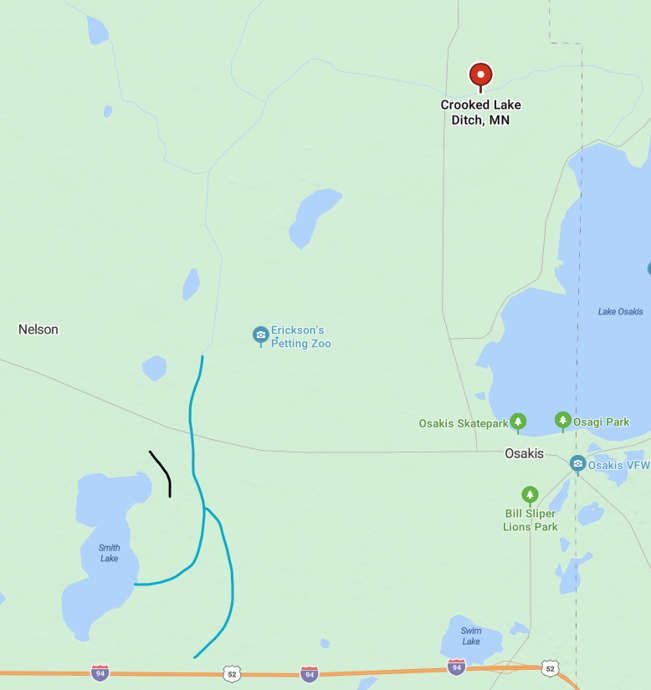
Black line represents our birding location.
Aqua line is Fairfield Creek.
Faint blue is Crooked Lake Ditch (aka JD2)
One could speculate whether Craig’s highly tuned skills can sense great birding locations based on historical surface water but let’s leave that for another STL report. Uncanny.
A wooded section with a meadow nearby and a farmhouse just up the road suggested good birding to Craig. He may have heard a Black-capped Chickadee. Exiting the cars we quickly added multiple warblers and other woods birds. Looking beyond the trees, a large bodied tern flew by – Caspian Tern. Take that you Pope County Forester’s Terns. This former Crooked Lake location yielded twenty-four species.
We followed Hidden Drive SE (aka Cty Road 31). It is ditched next to the road. Why? Now you know.
We heard a Marsh Wren and decided it was worth investigating. The Virginia Rail popped out of the cattails next to the cars and crossed the ditch close to several birders. Then disappeared.
Later Kathrynn would see the rail again from the end of the ditch while looking back toward the group. It declined to reappear, so we turned our attention to the whisperer of wrens. In Pope County I had become mesmerized by Rick’s gentle pishing. And so had the wren. He repeated the same technique here. It moved to the edge of the weeds and sat there looking curiously at Rick. Rick Wren Whisperer.
We turned our attention to a raptor perched in the trees. American Kestrel, Cooper’s Hawk, Sharpie? “Look at the eye” Craig said. The brown-eyed bird was positively identified. Our Tour Leader had proved his mastery again.
We turned to leave. Rick Wren Whisperer, called out the Virginia Rail almost at his feet. It now seemed unconcerned by sixteen pairs of binoculars and a few cameras as it worked its way up the ditch. Henceforth he shall be Rick Wren Whisperer Rail Wrangler. Joel posted some great pictures of the rail on eBird.
What could be better than Lake Osakis? The Osakis Sewage Ponds of course. We recorded a wide mix of 30 species – Trumpeter Swan, Hooded Merganser, Eurasian Collared-Dove, Spotted and Least Sandpipers, and both Yellowlegs. Add Purple Martins to the six species of swallows as they swooped and swirled when we played their call notes.
Looking for bathrooms and maybe a snack we stopped in Osakis. Fifty plus Purple Martins were staging on the communications tower outside town. Migration was in full swing.
At the gas station, an ID debate started after spotting what turned into a scruffy looking Merlin looking like she needed a snack delivered by mom.
We drove over to the boat ramp on Lake Osakis. On the Douglas side. Scanning the water, we were able to view a Western Grebe in Todd County. But we’ve had this debate already.
We drove over to Osagi Park to see if the birding was better or maybe we could lure the grebes over to Douglas County with our charm, wit, and personality. Or maybe Rick could….Nope, the alliteration stops here. No Gibson Grebe Grifting allowed. The Red-breasted Nuthatch kept calling but I could not find him in the trees. Eight species of warblers were seen. The Blue-grey Gnatcatcher was a little scruffy looking but easily identified by the long wagging tail and agitated call note. The Spotted Sandpiper agreed that Douglas was a good as Todd. But not the Western Grebes. Still, it’s on your eBird report. You’ll want to manage that Todd County report yourself.
We drove north along the western (Douglas) side of the lake then turned west on Ditch Drive NE. A dozen Sandhill Cranes were in the fields. As we turned north. A couple of birds flushed from the gravel road, circled, and returned. The lead car ditched us. (I couldn’t resist.) Car #4 pulled over to enjoy Horned Larks. Sometimes being the last car pays benefits. And cheers to Mark for driving.
Spruce Hill Lutheran Church, founded in 1876, and relocated to its present location in 1884 after don’tcha know “Ole Swenson donated a more suitable site” and Spruce Hill Cemetery are now managed by the county historical society. The mature conifers were full of cones causing us to wish-bird for Red Crossbills. There was a pair of Eastern Phoebes, a family of Chipping Sparrows, and thirteen other species we had already seen. I walked the cemetery grounds reflecting on all the changes since the early settlers arrived. Plenty of Nordic names. Can you imagine removing the trees, digging those ditches, plowing the fields, and harvesting with a couple of mules. Just thinking about it made me thankful for modern agriculture. And hungry. Time for lunch.
Spruce Hill County Park along the same Spruce Creek was not far away. We found a lovely picnic area along the creek. Wildflowers were blooming. We had a picnic shelter in the shade. A cool breeze caressed my brow. Wait, that was Pope County.
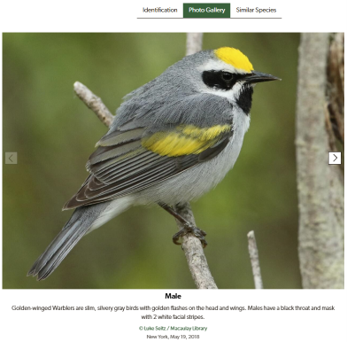
I had just sat down. People started calling out birds. There is no rest for a committed STL. Even if I wasn’t keeping the list. Plus, I needed numbers for this county to get over 100. Kathrynne was already calling out birds and adding them to the list. Warblers and vireos were working the trees and shrubs along the stream bank. And so was Kathrynn. She called out “It has bright yellow on the head and wings.” I rushed down to have a look. It had disappeared. I said, “maybe it was a Wilson’s?” “God, no” she said. “I think it’s a Golden-winged.” Finally, the little bugger came back out of the undergrowth. He was in bright plumage, similar to the picture below. She found a Swainson’s Thrush too. And probably half the rest of the birds we saw in that location. Joel did call out the “Philly” as he likes to call the Philadelphia Vireo (PHVI). He enjoys those colloquial names. I’ll have to start writing them down. A Yellow-throated Vireo was also seen and heard.
We were still wish-birding for crossbills, so we left the woodland and walked towards the rows of planted conifers. When we stopped along the forest edge the Ovenbird strenuously objected to our presence, fussing loudly with orange crest raised to full alert while walking up and back on a branch overhead. We were happy to watch, completely unintimidated. Joel took a decent picture for the eBird list. The Red-breasted Nuthatch wasn’t happy either. More warblers were seen. We had eight warblers for our efforts in the park and 29 species altogether. Including a Cooper’s Hawk and a Merlin. They too were happy many small birds were present. I hope they had a leisurely lunch.
Continuing to spruce up our list we added a Belted Kingfisher on none other than Spruce Center Drive NE. I don’t know about you but I’m pining for a different place to bird. Time to ditch this place and branch out so to speak. That’s what I’m rooting for. Oaky that’s enough of that nonsense. Time to flower elsewhere. Like Miltona’s WTP. Rick did say that MBW topics ranged from serious to scatological. I’ll avoid the poop jokes. My granddaughters have grown out of that phase. Gotta admit that sort of pissed me off. Alright already. Back to birding. Be that way. I’ll just look for agates and not help.
The Canada Geese must have realized this sewage pond was a safe place during the early hunting season because there were a lot of them. Some Trumpeter Swans, Wood Ducks, Ring-billed Gulls, and Red-winged Blackbirds completed the list. No shorebirds.
Eerily we recorded Turkey Vultures on Peaceful Lane NE. Now I’m not one to be superstitious. Nor I am easily taken in by a good story. Or a gag joke. Keep that firmly in mind for tomorrow.
Lake Carlos was our last stop for the day. I think I was either ready for an afternoon nap or a brisk hike to complete the 2.7 Hiking Club Trail as the sky clouded over threatening to rain on our parade. The Gray Catbird and Red-bellied Woodpecker were new for the day. And maybe the Bald Eagle. Time to head home to Alex. The Osprey on our way back was our last bird of the day.
La cena en el restaurante mexicano estuvo deliciosa. Disfruté la compañía de mis amigos.
September 7th – Labor Day
Rise up lowly worker! Get out of bed and get to work co-leading this MBW. What good are you anyway? Craig’s the expert and knows where to go. Frank does all the behind the scenes work to ensure everyone shows up on time. You don’t even do the checklists anymore. We can easily replace you with AI and a friendly robot. “Not so fast” I declared. “No robot can carry my heavy scope, shout out wrong names for fleeting birds beyond binocular range, and provide regular fodder for jokes by Paul and others.” “True,” Ms. Gemini admitted and slunk back to monitor every entry on my iPhone. Waiting….
Ha, I thought, I will plan a stunt for when the birding is poor, and interest starts to wane and county listers start to complain. I know, I will plant tablets with a strange language etched into them. I’ll bury them next to a tree. I won’t tell anyone. Well maybe Ole Olson down at the tavern. No, maybe I’ll just keep it a secret. I’ll stand behind the group as they tear into the mystery. Laugh at a good joke. Now, what to write? Maybe bird jokes.
A Norwegian robot analyzed a bird.
It Scandinavian.
All right, you’re smart people. You guessed it. Our destination this morning is Kensington Rune Stone Park. I decline to debate authenticity when I have enough trouble understanding how ditches get managed. I do have to admire the result. People came. They enjoyed the story. They enjoyed the area. Someone said, “let’s build a nice park”. More people came. The park was beautiful. Nice trails, fancy outhouses, modern welcome center, and good signage. You be the judge. I’m here to find some birds.
We spent a fair amount of time in the park. I wandered off again to admire the overlook and enjoy the quiet. The rest of the group birded down the hill from the extensive display and signage about the runestone and towards the visitor center. Several waves of warblers and other passerines made the birding productive. The observation that we had never seen so many Bay-breasted Warblers was repeated. And Cape Mays. We added Blue-headed Vireo too.
We walked back behind the center. As I was catching up with the group I spotted some nice holes in the oak trees. Eastern Screech Owls are probably more common than people realize. I scanned each hole. Craig taught me a new trick to rub the bark on the outside of the tree with a stick. “Sometimes this will cause them to pop out,” he said. Wait just a minute. Is this trick? Like a runestone. I tried it anyway. The human species is born gullible.
The most memorable new bird for me was the juvenile Red-headed Woodpecker that flew over near the visitor center and then perched along with his sister long enough to get scopes and admire the grey head and black and white plumage.
We needed some shorebirds if we were to pass those miserable Pope County Listers. Craig had a few more tricks up his sleeve.
We added American White Pelican on our way to a reported spot on Red Rock Lake. Cars 1-3 went down to the boat landing. Craig sent his crack investigative squad – Mark, Dan, Matt, and me – to check out the Viking Wildlife Management Area - South Unit. Wait a minute. We’re chasing Vikings again? One could only pray for a Super Bowl of birds.
We followed the road. It got narrower. There were fewer cabins ahead. We drove down a narrower road. We saw the last cabin on the left…..then a wood splitter. Let’s get out of here! We did stop on the way back to look through the trees to pick through fifteen or more Great Egrets. Carefully looking for Snowy Egrets. No yellow feet or black bills.
As we approached the boat ramp area, Craig radioed to say they had found a Western Grebe. Now all technicalities aside, this bird was solidly in Douglas County. No quibbles. No questions from MOU, ABA, eBird, Audubon, and all the other agencies and teams of people monitoring my every bird tick. The four of us jumped out of the truck and found the bird in Paul’s scope. Check. We were ready for our next hot spot. “Grebe and go,” Mark said. Which could lead to many new shopping options for MBWs and County Listers. Even day listers can access the offerings at www.mbwbirds.net/shopyourbird. Grebe and Go, Ducks with Chuck, Frank and Franklin’s, Vulture Adventures. The possibilities are endless. Look for them in 2029. There were no shorebirds. Desperate to supersede Pope we pushed on.
Two dogs ran across the road in front of us. One had a trick of standing in the road, then sideling over to block the lane and make the car stop. He wasn’t threatening. He wanted to say hello. We waved. They wandered off into the undergrowth. We proceeded until the view of Jennie Lake was excellent from the road. Out came all the scopes. There were several species of water birds on the lake. Okay, not shorebirds but not Mallards either. Canvasback, Blue-winged Teal, Ring-necked Duck, American Coot, Pied-billed Grebe, Franklin’s Gull. Another Marsh Wren buzzed from the cattails. A Sora called. Things were clicking.
Craig scanned the Franklin’s again. Bonaparte’s Gull! Everyone rushed to the scope to get a look. I don’t remember what distracted me. Maybe it was the dogs flushing multiple waves of Wood Ducks and Mallards from the shoreline. Maybe I was stubborn and tried to find the Boneparte’s in my scope instead. Rookie mistake. I missed the bird. Stubbornly I scanned the far shore. I scanned the far shore stubbornly. I scanned the far shore. One more time I scanned the distant water. What is that? Riding low in the water it was clearly a sea duck (diver). It was all dark with splotch of white on the head. I asked Craig to take a look. He started thinking. Angela walked up to have a look. “Long-tailed Duck,” she said with absolute certainty. Craig agreed. I believe this might be my first rare bird found first by me. Which is a MOU thing if you’re a birder. I was happy everyone was able to observe it before it swam out of sight. Angela was kind enough to give me credit on the Discord app. Another first. I did not get a heart emoji though. ☹
We tried a couple of other spots for shorebirds without results. We did find more Horned Larks so more people were able to add them to their day lists.
And so, we return to our last bird of the trip. Have you made up your mind on the countability of the that Ring-necked Pheasant? Of course I have. I probably need it for the county.
We returned to the hotel breathless with anticipation for the final checklist. 112 species. A good number. But not Pope’s 117. Upon further investigation of the MBWbirds.NET rules committee’s rather lax documentation, several obscure and mundane bylaws were uncovered; “a rare county bird counts for five points.” Douglas County Total: 117. It’s a tie! Prizes and trophies for everyone. Note: Subject to review by the recalcitrant and dogmatic county listers committee.
Mammals: White-tailed Deer, Muskrat, Eastern Chipmunk, Red Squirrel, Gray Squirrel, Fox Squirrel.
Research, Notes, Observations, Fun Facts
Alphabetic Bird Codes
Standardized 4- and 6-letter Bird Species (“Alpha“) Codes. Sometimes known as Banding Codes.
List of counties in Minnesota - Wikipedia https://en.wikipedia.org/wiki/List_of_counties_in_Minnesota
Ditches & Streams, Watersheds
Crooked Lake Ditch Topo Map in Douglas County, Minnesota
JD2 Project Team | Sauk River Watershed District
Understanding Our Streams and Rivers
Water law basics | Minnesota DNR
Workbook: Watershed project managers
Public Drainage Ditch Systems | Minnesota DNR
Water quality | Minnesota Pollution Control Agency
Search Content | WRL Digital Asset Management
Spruce Hill Church and Cemetery
Spruce Hill Church | Preserving Nordic American Churches